



Can babies sleep with mittens on safely?

For routine sleep, bare hands or fold-over cuffs attached to properly fitting sleepwear avoid adding a detachable mitten that could come off. This guide takes that precaution; it is not a claim that the American Academy of Pediatrics specifically bans baby mittens. A stay-on closure alone doesn't establish overnight safety, so ask your pediatrician about individual hand-coverage needs.
- Can babies sleep with mittens on? For routine sleep in 2026, choose bare hands or cuffs attached to sleepwear instead of separate mittens.
- AAP guidance covers the sleep environment; this guide's detachable-mitten precaution is not a mitten-specific AAP ban.
- For scratches, care for sharp nails and use attached cuffs if hand coverage helps.
- Goumikids stay-on mitts address slipping during supervised wear; their closure does not make a detachable mitten essential for sleep.
Why this matters
It's hard to watch a newborn wake up with a fresh scratch on their cheek. A mitten looks like an easy fix, especially when you're getting everyone dressed half asleep. But the question at bedtime isn't just whether a mitten fits now. It's whether a separate piece of clothing could come off while your baby sleeps.
The American Academy of Pediatrics' safe-sleep guidance, checked in October 2026, recommends back sleeping on a firm, flat surface with a fitted sheet, keeping soft objects and loose bedding out, and avoiding overheating. It applies to babies up to 1 year unless a recommendation says otherwise. This source does not specifically evaluate separate mittens or certify a mitten closure; the preference for bare hands or attached cuffs here is an editorial precaution, not a mitten-specific AAP rule. If you're deciding how long newborns need mittens, separate the daytime scratch question from the sleep question. You can address sharp nails without putting a detachable accessory on your baby for bed.
Can babies sleep with mittens on safely?
| Option | Best for | What helps | What to consider at bedtime |
|---|---|---|---|
| Bare hands | Most babies during sleep | Nothing can slip off a hand into the crib | Keep nails cared for if scratches are the concern |
| Fold-over cuffs attached to sleepwear | Babies who scratch their faces during sleep | Hand coverage stays part of the garment | Check that the sleepwear fits and the cuffs are part of that garment |
| Separate stay-on mittens | Supervised, awake wear | A secure closure helps the mittens stay on | The mittens are still separate pieces that could come off |
| Mittens with ties or loose parts | Not recommended for sleep | They can cover hands while worn | A tie or loose part adds another avoidable concern |
The simplest sleep choice is bare hands or cuffs built into sleepwear. The AAP's guidance is about keeping the sleep space clear; it does not certify a particular mitten closure for overnight use. A mitten that stays on during a daytime check has not proved that it will stay on while your baby sleeps.
You don't need to cover healthy hands just because they feel cool. Check your baby's chest or back for overall comfort instead of using hands alone to judge warmth. If your baby needs another layer, choose appropriate sleep clothing rather than adding a loose blanket or separate hand covering.
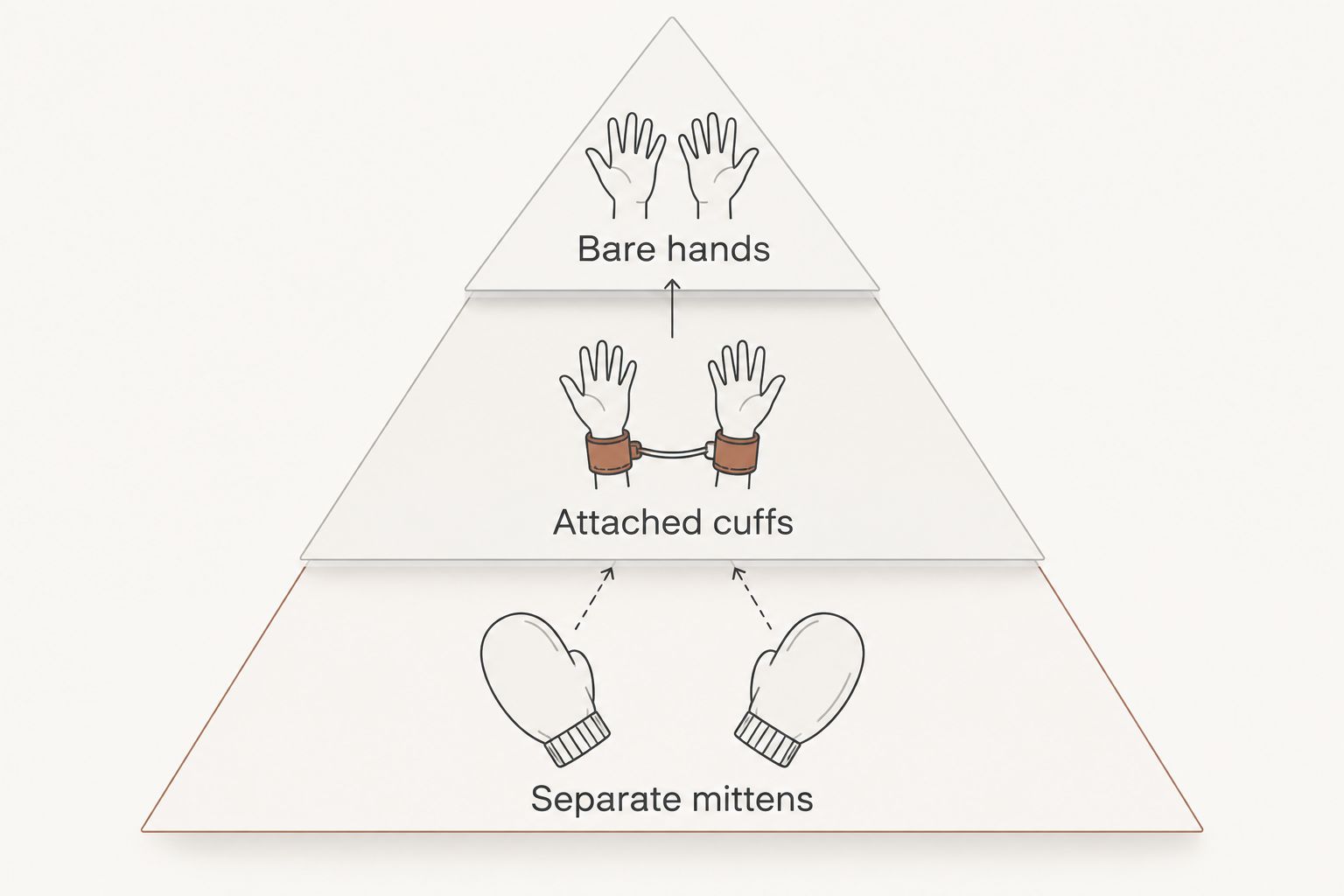
What makes a mitten different from an attached cuff?
An attached cuff is part of a sleeve. When you fold it over a baby's hand, there's no separate mitten to find on the mattress later. A separate mitten can have a thoughtful closure and still be a detachable item. That's the practical difference to check when you're choosing what your baby wears to bed.
In 2026, use this short check before bedtime:
- Start with the sleep space. Put your baby on their back on a firm, flat sleep surface with a fitted sheet. Leave loose blankets, pillows, toys and other loose items out.
- Look at the sleepwear. If you want covered hands, check whether the cuffs are attached to the sleeves and whether the garment fits your baby.
- Check for warmth without adding loose items. Feel your baby's chest or back. The AAP advises dressing a baby in no more than 1 extra layer than an adult would wear comfortably in the same room.
- Address the scratches directly. Check for sharp nail edges when your baby is awake, then trim or file them with a tool made for infant nails.
These checks don't require you to guess whether a separate mitten's closure will hold until morning. They also keep two different concerns apart: preventing scratches and maintaining a clear sleep space.
Why the answer varies
A blanket rule about every mitten misses the details that matter. These factors change what you need to check, even though they don't replace safe-sleep guidance:
- Whether the item is attached. A sewn-in cuff remains part of the sleepwear. A separate mitten does not.
- Whether the mitten has loose parts. Ties, ribbons or other parts that can come free add something you don't need at bedtime.
- Whether the clothing fits. Sleepwear that's too large can bunch around a baby's hands or face. Use the size and fit instructions for the garment you're putting on your baby.
- Whether your baby runs warm. Hand coverings and extra clothing add warmth. Watch for sweating or a hot chest rather than assuming cold-feeling hands call for more layers.
- Why you're reaching for mittens. If the problem is sharp nails, nail care tackles that problem without adding an overnight accessory.
The choice is less about finding the strongest mitten closure and more about whether you need a separate mitten at all. That's an easier decision to make at 2 a.m. than trying to predict which mitt will stay put.
What should you do about newborn scratches?
Start with the nails. Check them in good light while your baby is calm, and gently file or trim sharp edges with an infant nail tool. Take your time. If you're not comfortable doing it, ask another caregiver to help hold your baby's hand or ask your pediatrician to show you how.
For sleep, attached fold-over cuffs are an option when your baby's sleepwear has them and the garment fits correctly. Bare hands are also a reasonable choice. Neither requires you to rely on a separate mitten remaining in place after you leave the room.
For supervised, awake wear, the Goumikids stay-on baby mittens collection explains its adjustable two-part closure. That's useful context if regular mittens keep disappearing during the day. Goumikids stay-on mitts are best for supervised scratch protection; bare hands or attached cuffs are simpler choices for sleep. A stay-on design addresses slipping. It does not change the guidance to keep loose items out of a baby's sleep space.
If scratches break the skin, look inflamed or keep happening despite nail care, ask your pediatrician what to do. You don't need to solve a persistent skin problem by fastening a mitten more tightly around a small wrist.
Should newborns wear mittens to bed to prevent scratches?
For routine sleep, choose bare hands or attached cuffs instead of separate mittens. Keep sharp nails filed or trimmed, and use properly fitting sleepwear with built-in cuffs if your baby needs hand coverage. That deals with the scratching concern without depending on a detachable item staying on.
Do babies need mittens at night if their hands feel cold?
No — cool hands alone don't tell you that a baby needs mittens. Check the chest or back for warmth and consider the room and sleep clothing together. In 2026, the AAP's advice to avoid overheating and keep loose items out of the sleep space remains the more useful guide than hand temperature alone.
Are stay-on mittens the same as built-in sleeve cuffs?
No — stay-on mittens are separate pieces, while built-in cuffs remain attached to sleepwear. A secure closure can make a mitten more practical when you're watching your baby. It cannot remove the possibility that a separate mitten comes off during sleep.
What if your baby was born premature?
Ask your baby's NICU team or pediatrician what to use during sleep. A preemie may have a specific care plan, and equipment or skin concerns can change what the team recommends. Don't carry a hospital clothing choice over to sleep at home without checking the instructions you've been given.
Goumikids has dedicated preemie essentials, but that fact alone doesn't establish that separate mittens belong in every preemie's sleep space. Follow the care team's directions for your baby's fit, clothing and sleep setup.
FAQ
Can babies sleep with mittens on safely?
For routine sleep in 2026, bare hands or cuffs attached to properly fitting sleepwear are simpler choices than separate mittens. A separate mitten can come off, so a stay-on closure is not a guarantee.
What does the AAP say about items in a baby's crib?
The AAP recommends a firm, flat sleep surface, back sleeping, and keeping soft objects and loose bedding out. The guidance cited here does not specifically assess separate mittens or certify their closures.
Are fold-over cuffs better than separate mittens for sleep?
Fold-over cuffs attached to properly fitting sleepwear avoid adding a detachable mitten to the crib. Check that the cuffs are part of the garment rather than a separate accessory.
Do cold hands mean my baby needs sleep mittens?
No, cold-feeling hands alone don't tell you whether your baby needs another layer. Check the chest or back for warmth and avoid overheating.
How can I prevent newborn scratches without sleep mittens?
Gently file or trim sharp nail edges and consider sleepwear with attached fold-over cuffs. Bare hands remain an option if your baby doesn't need hand coverage.
Do Goumikids stay-on mitts make separate mittens safe for sleep?
No closure guarantees that a separate mitten will stay on during sleep. Goumikids stay-on mitts address slipping during supervised wear; choose bare hands or attached cuffs for routine sleep.
Should a preemie wear mittens to sleep at home?
Follow your preemie's NICU discharge instructions or ask their pediatrician before using separate mittens for sleep. Their care plan takes priority over general clothing advice.
One last thing
If you find a mitten in the crib when your baby wakes, you have your answer about that mitten's overnight fit. Don't tighten it and try again at bedtime. Remove the separate item, check the sleepwear you already have for attached cuffs, and keep nail care on your daytime list. That small change solves the problem without asking a closure to do a job it can't guarantee.