



Can preemie mittens fit a full-term newborn? Yes | 2026

Yes, preemie mittens can fit a full-term newborn if the hand has room inside and the cuff sits comfortably around the wrist. Being born full-term doesn’t automatically rule out a smaller mitten size. Choose by the fit on your baby, not the word on the label—a mitten that stays on but squeezes the hand isn’t the right fit.
- Can preemie mittens fit a full-term newborn? Yes, if the fingers have room and the wrist closure isn’t tight.
- Preemie mittens aren’t automatically right for every small newborn; check the actual pair on your baby.
- Goumikids baby mittens offer a two-part stay-on closure; the closure doesn’t replace checking hand room.
- Switch sizes when the mitten crowds the fingers, presses into the wrist, or becomes difficult to put on.
Can preemie mittens fit a full-term newborn?
Yes, but a preemie label alone doesn’t establish a good fit. You need enough space for the hand and a cuff that holds the mitten without pressing into the skin. Those are separate checks.
A smaller mitten isn’t automatically the answer when a larger pair falls off. The problem might be the wrist opening rather than the space around the fingers. For that situation, start with how to keep preemie mittens from falling off, then check the hand space before choosing a smaller size.
Use this comparison when deciding which size to try in 2026. These are fit-based starting points, not universal size ranges.
| Option | Best for | What works | What to watch |
|---|---|---|---|
| Preemie mittens | A newborn whose hands fit comfortably inside the smaller pair | A smaller shape can fit without excess fabric | The hand area or wrist opening can be too small |
| Newborn-size mittens | A newborn who needs more hand room than the preemie pair provides | The larger size gives room when the smaller pair crowds the hand | A loose wrist opening can let the mitten slip off |
| A different mitten shape or closure | A baby whose current pair is roomy inside but loose at the wrist | A different design can address the wrist fit without downsizing the hand area | You still need to check both the hand and the cuff |
There’s no need to make the size label match every other piece of clothing. A baby’s gown can fit well while a mitten from the same labeled size doesn’t. Judge each piece by the part of the body it covers.
Why this matters
You’ve just finished a diaper change, pulled the sleeves back into place, and found another mitten beside the changing pad. It’s tempting to reach for the smallest pair so it stays put. A secure fit and a tight fit are not the same thing.
The useful question isn’t simply whether you can get the mitten on. It’s whether it fits comfortably after you’ve closed it and your baby moves their hand. A pair that takes effort to pull over the hand deserves another look, even if the cuff seems secure afterward.
For your 2026 newborn checklist, treat mitten sizing as a try-on decision. Don’t build the whole plan around a preemie or newborn label before you’ve checked the actual fit.
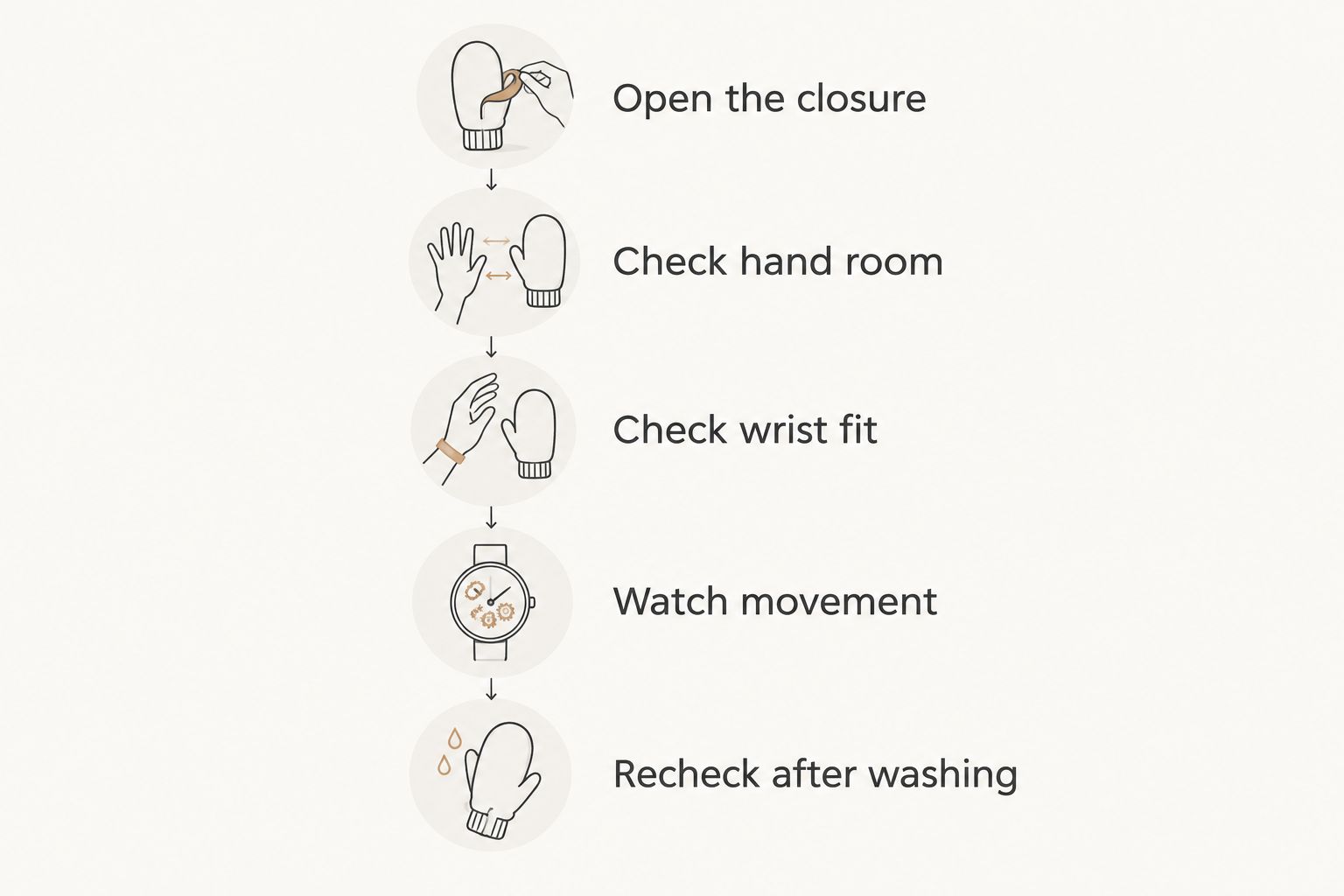
Check the fit before keeping the pair on
Try the mittens while your baby is awake and you can see the hands clearly. Open any fastening before putting the mitten on, and follow the instructions for that exact style. Don’t pull a closed cuff over the hand just to make the size work.
Open the closure
Start with the cuff fully open if the design allows it. Guide the hand in gently rather than tugging the fabric or pulling on the fingers. If dressing turns into a struggle, stop and reassess the size or opening.
An open cuff can make entry easier, but it doesn’t prove that the inside is large enough. Check the hand area next. This is especially useful when a mitten has a closure that opens wider than its resting fit.
Check hand room
Look for room around the fingers without fabric pulling tightly across the hand. Don’t judge the fit only while the hand is clenched. Your baby needs room to move the fingers inside the mitten.
If you can only fit the hand by stretching the mitten firmly around it, try another size or shape. Soft fabric can still fit too tightly. The feel of the material doesn’t cancel out a cramped fit.
Check wrist fit
Fasten the closure as instructed, then look at where the cuff meets the wrist. It should hold the mitten without digging in or requiring you to pull it tightly. Don’t tighten a cuff to compensate for the wrong size.
Check for redness or an indentation when you remove the mitten. If you see pressure marks, take the pair off and reassess rather than fastening it more loosely and assuming the problem is solved.
Watch movement
Let your baby move their arms and hands while you watch. Notice whether the mitten slides away from the wrist, bunches, or stays in place without pulling. Movement adds information that a quick glance during dressing doesn’t give you.
If the pair slips off, return to the wrist check. If the fingers look crowded, return to the hand-room check. Those problems need different fixes.
Recheck after washing
Follow the care label for the exact pair, then check the fit again before use. Don’t assume a washed mitten feels or fits exactly as it did when you first opened it. Look at the hand space, cuff, seams, and condition of the fabric.
Make this part of your 2026 clothing routine rather than a separate task. When a clean pair comes back into the drawer, give it a quick check before it goes back on your baby.
Preemie mittens: best for a comfortable smaller fit
A preemie pair makes sense when it fits your newborn’s hands comfortably and the cuff works without squeezing. That remains true even if your baby was born full-term. The label describes the intended size, not a requirement about who can wear it.
The trade-off is limited room if the hand already fills the mitten. Don’t keep using a smaller pair just because it stays on better than another pair. Staying on is useful only when the rest of the fit works too.
Choose the preemie pair when both the hand and wrist checks pass. If either check fails, try another size or design. You don’t need to wait until dressing becomes difficult to make the change.
Newborn mittens: best for hands that need more room
A newborn-size pair is the better starting point when the preemie mitten pulls across the hand or crowds the fingers. It still needs a wrist check. More space inside doesn’t automatically mean the cuff will fit well.
If the newborn pair falls off but the preemie pair is tight, don’t settle for either problem. Look for a different shape or fastening that lets the hand fit without relying on a squeezed wrist.
Choose hand room first, then check how the cuff holds. This keeps you from treating a loose closure as proof that your baby needs the smallest size.
What a stay-on closure does—and doesn’t do
A closure helps hold a mitten around the wrist. It doesn’t enlarge the space around the fingers. Keeping those jobs separate makes shopping simpler, especially when you’re comparing pairs on a small screen while holding your baby.
Goumikids baby mittens suit parents who want a two-part stay-on closure. The product descriptions for the preemie Storm Gray pair and Stay On Baby Mittens in Midnight identify that closure feature. You still need to check the fit of the exact size you choose.
| Product | Best for | Stated feature | Fit limitation |
|---|---|---|---|
| GOUMIKIDS PREEMIE STAY ON MITTS — STORM GRAY | Parents considering a preemie pair with a stay-on closure | Signature two-part closure | The preemie label doesn’t confirm a full-term newborn’s hand fit |
| STAY ON BABY MITTENS — MIDNIGHT BY GOUMIKIDS | Parents comparing another mitten option with a stay-on closure | Signature two-part closure | Check the selected size; the closure alone doesn’t establish comfort |
Goumikids offers these options, but neither product name tells you whether your baby’s fingers have enough room. Use the product’s sizing information, then confirm the fit on your baby. Don’t assume that every style has the same dimensions or fabric composition.


Why preemie mitten fit varies
For 2026 shopping, compare the exact pair rather than assuming all preemie mittens fit alike. The details that matter are the ones you can check against your baby’s hand.
- Hand space: The inside must accommodate the fingers without pulling tightly across them.
- Wrist opening: A pair can fit the hand but still be too loose or tight around the wrist.
- Closure design: The fastening affects how you put the mitten on and how it sits once closed.
- Fabric and seams: Check how the actual material and seam placement feel, rather than choosing by a fabric name alone.
- Condition after care: Recheck a washed or previously worn pair instead of relying on its original label.
None of these checks requires you to predict how long the size will last. You’re choosing what fits now. When that fit changes, change the pair.
Does my baby’s clothing size tell me their mitten size?
No, clothing size doesn’t establish mitten fit. A gown’s fit and a mitten’s fit depend on different parts of the body. Use the mitten’s own sizing guidance and check it on the hand.
If you’re buying a matching outfit, don’t let the matching label make the decision for you. It’s fine for the mittens and gown to carry different sizes if each piece fits comfortably.
Should I buy preemie mittens before my full-term baby arrives?
Don’t choose preemie mittens solely because you expect a small newborn. Check the exact product’s sizing guidance, and avoid treating a predicted clothing size as a confirmed hand measurement.
For a 2026 hospital-bag checklist, leave room to adjust your choice after birth. If your baby needs hospital care, ask the care team which clothing and hand coverings are appropriate before putting them on.
When should I stop using the preemie pair?
Stop using the preemie pair when it no longer passes the hand-room and wrist-fit checks. Crowded fingers, a cuff that presses into the wrist, or difficulty getting the mitten on are reasons to reassess.
Don’t wait for a particular age or a change in gown size. Check the hands themselves. A mitten that fit earlier isn’t automatically the right pair today.
FAQ
Can preemie mittens fit a full-term newborn?
Yes, preemie mittens can fit a full-term newborn when the fingers have room and the cuff sits comfortably. Full-term birth alone doesn’t determine mitten size.
Are preemie mittens too tight for a newborn?
Preemie mittens are too tight if they crowd the hand or press into the wrist. Remove a pair that leaves pressure marks and reassess the size or design.
Should I size down if newborn mittens keep falling off?
Don’t size down unless the smaller pair also gives the hand enough room. A loose wrist opening and a roomy hand area are separate fit issues.
Does a stay-on closure mean the mitten fits properly?
No, a stay-on closure doesn’t prove that the mitten fits properly. Check finger room and wrist comfort separately from whether the mitten stays on.
Do Goumikids preemie mittens fit every full-term newborn?
No single preemie size is a guaranteed fit for every full-term newborn. Check the exact Goumikids style’s sizing information and confirm the fit on your baby.
Can I use a preemie mitten if my baby wears newborn gowns?
Yes, if the mitten fits the hand comfortably. A gown’s size doesn’t establish the right mitten size.
Should I check mitten fit again after washing?
Yes, check mitten fit again after washing and follow the pair’s care instructions. Look at hand room, wrist fit, seams, and fabric condition before use.
Can a baby in hospital wear the mittens I brought from home?
Ask your baby’s care team before using mittens in hospital. Clothing choices need to work with your baby’s care and any equipment in use.
One last thing
The mitten that falls off gives you useful information—but not necessarily a reason to size down. Check where the fit fails before changing the size. If the hand area fits and only the wrist is loose, a different closure or shape is the more relevant comparison.
Keep that distinction in mind during the next half-asleep clothing change. You’re not trying to make the label work. You’re finding the pair that fits the baby in front of you.