



Is organic cotton warmer than bamboo for babies?

Organic cotton isn’t automatically warmer than bamboo for babies. A garment’s thickness, construction, coverage, and layers determine warmth more than the fiber name alone. For a nighttime change, choose clothes for the room and your baby’s comfort—not because the label says organic cotton or bamboo.
- Is organic cotton warmer than bamboo for babies? No automatic winner: compare the finished garments, not just their fibers.
- Organic cotton describes how cotton is grown, not how warm a baby outfit is.
- Bamboo viscose baby clothing can be lightweight or substantial; construction changes the result.
- Goumikids baby clothing includes bamboo–organic cotton blends; a blend label alone doesn’t establish warmth.
Why this matters
You’re getting your baby dressed, a sock has disappeared, and the room feels cooler than it did earlier. It’s tempting to solve the whole question with one fabric choice. But choosing cotton instead of bamboo doesn’t tell you whether the outfit is thick enough—or whether you’ve added too much.
For your 2026 baby wardrobe, start with the actual garment. Goumikids offers baby essentials that combine bamboo and organic cotton, so these fibers aren’t always competing choices. You still need to look at the item’s fabric, fit, and coverage.
Choose the outfit for the conditions, not the fiber for its reputation. That keeps the decision useful when you’re dressing a baby half asleep.
Is organic cotton warmer than bamboo for babies?
No. Organic cotton is not inherently warmer than bamboo-based fabric. A thick cotton garment can be warmer than a thin bamboo-viscose garment, while a substantial bamboo blend can provide more insulation than a lightweight cotton outfit.
The comparison only becomes meaningful when you compare similar garments. A short-sleeved cotton bodysuit and a long-sleeved bamboo sleeper differ in coverage as well as fabric. Neither tells you which fiber is warmer on its own.
| Fabric option | Best for | What it tells you | Useful advantage | Important limit |
|---|---|---|---|---|
| Organic cotton | Parents who specifically want organically grown cotton | The cotton’s growing method, when accurately labeled | Cotton garments come in different constructions for different uses | Organic status is not an insulation rating |
| Bamboo viscose | Parents who prefer the feel of a particular viscose garment | The processed fiber used in the fabric | Gives you another fabric option to compare by touch and construction | Bamboo wording does not prove a garment is cooling or warmer |
| Bamboo–organic cotton blend | Parents who want both fibers in one garment | The fibers combined in the fabric | You don’t have to choose exclusively between cotton and bamboo | The blend name does not describe thickness, warmth, or exact proportions |
Fabric traps air within its structure, and that trapped air contributes to insulation. Thickness, loft, and the way the fabric is made affect that structure. The fiber name is only part of the picture.
A smooth, lightweight knit and a thicker, lofty fabric aren’t interchangeable, even if both contain cotton. The same applies to bamboo-based fabrics. Compare like with like before choosing a warmer outfit.
Organic cotton: check the construction
Organic cotton is a reasonable choice when you want cotton grown under organic standards. That’s a material preference, not a promise that your baby will feel warmer.
For warmth, inspect the garment itself. Is it thin or substantial? Does it cover the arms and legs? Is it a single layer, or does the construction include additional fabric?
A lightweight organic cotton outfit still needs to suit the room and the rest of your baby’s clothing. A thicker organic cotton outfit still needs checking for overheating. Organic doesn’t remove either step.
Best for: parents who want organically grown cotton and will choose the garment’s construction separately. The advantage is a clear fiber preference. The limitation is that the word organic cannot answer your temperature question.
Bamboo: check what the label means
Many garments described as bamboo clothing use viscose or rayon made from bamboo. Those are manufactured fibers made by processing plant cellulose; they aren’t simply strips of the original plant woven into clothing.
The Federal Trade Commission’s textile-labeling guidance distinguishes bamboo fiber from rayon or viscose made from bamboo. That distinction helps you understand what you’re buying. It does not establish how warm the finished garment will be.
When shopping in 2026, read the full fiber label rather than stopping at bamboo in the product name. Check whether the garment contains viscose, cotton, or other fibers, then compare its construction with the alternative you’re considering.
Best for: parents who like the feel of a specific bamboo-based garment. The useful part is finding a fabric you’re comfortable handling and dressing your baby in. The limitation is that a soft feel—or a cooling description—doesn’t replace checking your baby’s comfort.
Blends: neither a warmth score nor a compromise
A bamboo–organic cotton blend contains both fiber types. That alone doesn’t make it halfway between warm and cool, and it doesn’t establish a fixed level of insulation.
The proportions matter when you’re comparing composition, but they still aren’t a complete warmth measurement. The finished fabric’s weight and construction also matter. Read the exact item’s label rather than assuming every garment from a brand uses the same recipe.
For your 2026 shopping list, compare blend garments by their intended use and physical features. A convertible gown, footie, and pair of mitts do different jobs even when their material descriptions sound alike.
Best for: parents who want a garment combining bamboo-derived fiber and organic cotton. The advantage is that both fibers can appear in the same useful piece. The limitation is that the blend description won’t tell you how many layers your baby needs.
Why warmth varies
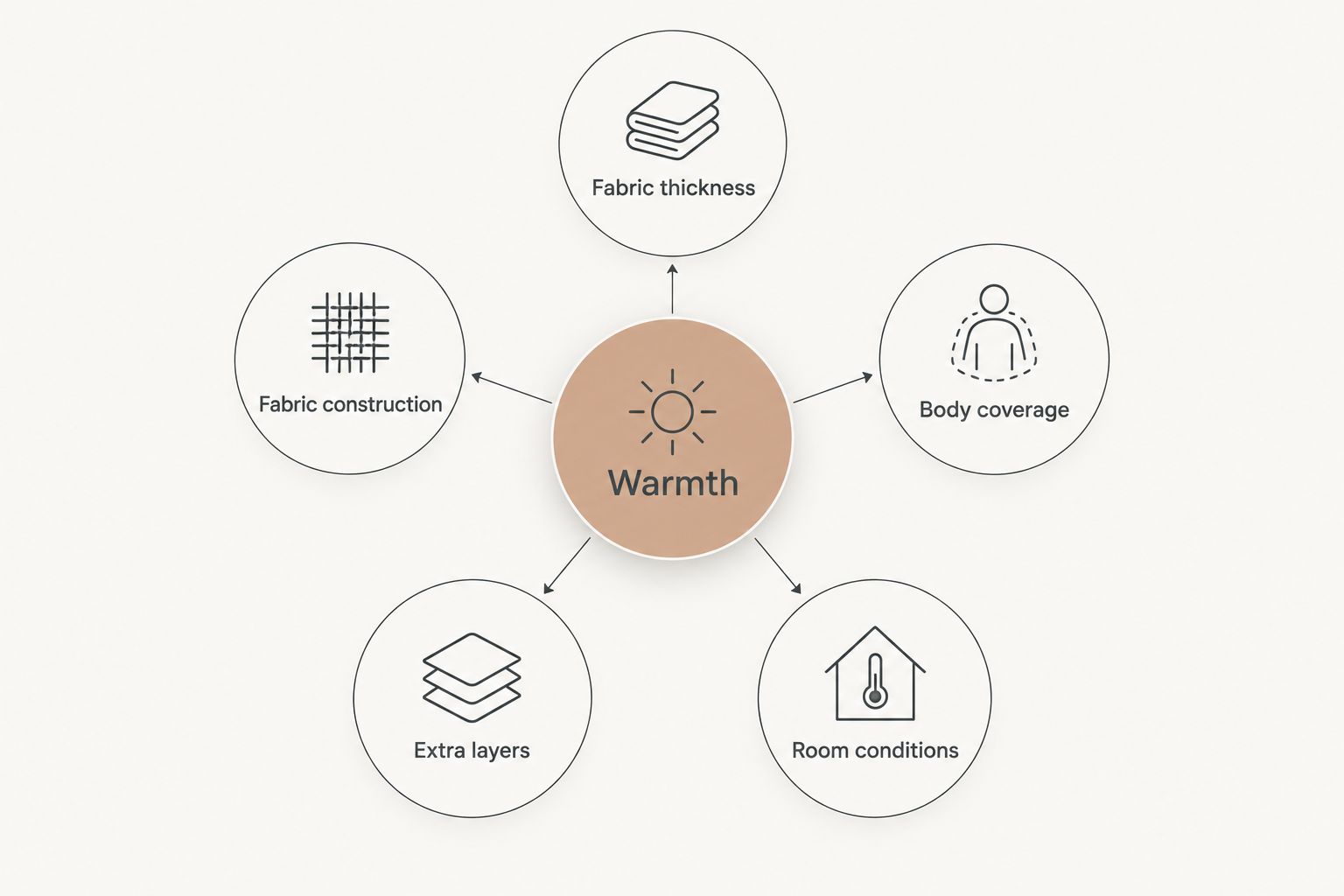
The most useful comparison happens at garment level. These factors explain why two outfits with similar fiber labels can feel different:
- Fabric thickness: A thin fabric and a substantial fabric provide different amounts of material around your baby.
- Fabric construction: Knit, weave, and loft affect how the fabric holds air and allows airflow.
- Body coverage: Sleeves, legs, and foot coverage change how much skin the outfit covers.
- Extra layers: An undershirt or other clothing changes the whole outfit, not just one garment.
- Room conditions: The same outfit needs a fresh comfort check when the surroundings change.
You don’t need to turn this into a fabric science project. Hold the clothes, read the labels, and compare pieces designed for the same job. Then check your baby rather than assuming the fabric has handled everything.
Keep the nighttime choice simple
You don’t need a separate cotton-versus-bamboo rule for every diaper change. A repeatable check is more useful than trying to remember which material is supposed to feel cooler.
- Read the label. Confirm the fiber composition and care directions for the exact garment.
- Check the outfit. Notice thickness, coverage, fit, and any layers already underneath it.
- Check your baby. Feel the chest or upper back rather than deciding from cold hands alone.
- Adjust as needed. If your baby feels hot or sweaty, reduce clothing and reassess.
The American Academy of Pediatrics’ safe-sleep guidance advises dressing babies in no more than 1 extra layer than an adult would wear comfortably in the same environment. That’s a starting point, not a reason to ignore sweating or a hot chest.
For sleep, keep loose blankets out of the sleep space and follow safe-sleep guidance alongside garment instructions. Don’t use a heavier outfit as a reason to add bedding, and don’t assume a bamboo label prevents overheating.
If your baby is premature, unwell, or has specific care instructions, ask the care team how to dress them. A general fabric comparison doesn’t replace advice for your baby.
Choose function before a fabric winner
A gown that suits your changing routine solves a different problem from choosing a warmer fabric. Keep those decisions separate. First decide what you need the garment to do, then check whether its material and construction suit your baby’s conditions.
Goumikids baby clothing is a fit for parents who want functional essentials such as convertible gowns and stay-on accessories. That recommendation is about the stated garment features, not a claim that the brand’s blends are warmer than cotton.
These two gowns are described as bamboo–organic cotton blends. Their listed size spans run from preemie through 6 months, but you should select the exact size using the item’s sizing guidance rather than treating that span as one fit.
| Gown | Best for | Stated feature | What to check |
|---|---|---|---|
| 24 Hour Convertible Gown — Storm Gray | Parents seeking a convertible gown in Storm Gray | Patented convertible sleeper gown; bamboo–organic cotton blend | Exact size, composition, and instructions for the item |
| 24 Hour Convertible Gown — Sandstone | Parents seeking a convertible gown in Sandstone | Patented convertible sleeper gown; bamboo–organic cotton blend | Exact size, composition, and instructions for the item |
Both options offer the stated convertible design. Neither product’s blend name establishes a warmth advantage over an organic cotton gown. Choose between them for the item you want, not an assumed temperature difference.


Is bamboo better for a baby who gets hot?
Bamboo-based clothing is not an automatic solution for a baby who gets hot. Choose an appropriately lightweight outfit, check the room and layers, and watch for overheating rather than relying on the fiber name.
A garment that feels cool in your hand still becomes part of a complete outfit when worn. Your baby’s comfort check matters more than the first touch.
Should I choose organic cotton for winter?
Choose winter clothing by construction, coverage, and conditions—not organic status alone. A substantial cotton garment and a lightweight cotton garment serve different needs, even when both use organically grown cotton.
For winter 2026, separate outdoor dressing from indoor sleepwear decisions. Recheck clothing when you move into a heated room instead of leaving every outdoor layer on by default.
Can I use the same fabric all year?
You can choose the same fiber category throughout the year while changing garment thickness and layers. You don’t need to replace every cotton outfit with bamboo for summer, or every bamboo blend with cotton for winter.
Choose pieces for the actual setting. The useful question is whether the finished outfit fits the conditions—not whether your wardrobe follows a seasonal fiber rule.
FAQ
Is organic cotton warmer than bamboo for babies?
Organic cotton is not automatically warmer than bamboo-based fabric. Compare garment thickness, construction, coverage, and layers before deciding which outfit provides more warmth.
Does organic cotton keep a newborn warmer than regular cotton?
Organic status does not establish a warmth advantage over regular cotton. It describes how the cotton is grown, while the finished fabric’s construction affects insulation.
Is bamboo baby clothing always cooling?
Bamboo baby clothing is not always cooling. A lightweight garment and a substantial garment can behave differently even when both contain bamboo-derived viscose.
Should I add a layer if my baby’s hands feel cold?
Cold hands alone are not a reliable reason to add a layer. Check your baby’s chest or upper back and consider the room and existing clothing.
Can a baby overheat in bamboo pajamas?
A baby can overheat in bamboo pajamas. The fiber name does not prevent overheating, so check for sweating or a hot chest and adjust clothing as needed.
Are Goumikids convertible gowns warmer than cotton gowns?
A bamboo–organic cotton blend does not establish that Goumikids convertible gowns are warmer than cotton gowns. Compare the exact garments’ construction, coverage, and fit.
How many extra clothing layers should a baby wear for sleep?
American Academy of Pediatrics guidance recommends no more than 1 extra layer than an adult would wear comfortably in the same environment. Check your baby for overheating rather than treating that guidance as a fixed outfit formula.
One last thing
The word organic answers a growing-method question, not a warmth question. Bamboo answers a fiber-source question only when the full label explains the material. Neither replaces holding the garment and checking your baby.
For your next 2026 clothing choice, put comparable outfits side by side. Check thickness, coverage, and the label. You don’t need a winning fiber—you need an outfit that fits the moment.