



Baby Sleep in a Convertible Gown: Yes, With Care | 2026

Yes, a baby can sleep in a convertible gown when the garment is intended for sleep, fits correctly, stays clear of the face, and is used according to its instructions. The gown doesn’t replace a safe sleep setup: put your baby on their back on a firm, flat, separate sleep surface with a fitted sheet and no loose bedding.
- Is it safe for a baby to sleep in a convertible gown? Yes, with correct fit and safe sleep practices.
- The American Academy of Pediatrics recommends back sleeping and a firm, flat sleep surface without loose bedding.
- Goumikids convertible gowns suit parents seeking adaptable baby sleepwear; conversion features don’t establish safety on their own.
- Check the neckline, fasteners, warmth, and intended sleeping configuration before every sleep.
Is it safe for a baby to sleep in a convertible gown?
A properly fitted convertible gown can be sleep clothing, but it isn’t a safety device. The important question is how the exact garment fits and functions on your baby, not whether its name includes the word convertible.
For this 2026 guide, the safe sleep foundation comes from the American Academy of Pediatrics’ infant sleep guidance and the National Institutes of Health’s Safe to Sleep program. Those recommendations address sleep position, the sleep surface, overheating, and objects in the sleep space. They don’t certify an individual gown.
Before you use one for sleep, check these points:
- Read the instructions. Confirm that the garment is intended for sleep and identify the configurations the manufacturer permits.
- Check the neckline. It should stay below the chin and shouldn’t slide toward the mouth or nose when your baby moves.
- Secure the closures. Use the fasteners as directed. Don’t leave loose ties, broken snaps, or detached pieces near your baby.
- Check movement and warmth. Your baby’s hips and legs should have room to move without unnecessary layers.
- Check the sleep space. Use a firm, flat mattress in an appropriate crib, bassinet, or play yard, with only its fitted sheet.
For help understanding the clothing itself, read how convertible baby gowns work. Understanding the conversion is useful; checking the fit on your own baby is essential.
Why this matters at bedtime
A diaper change can leave you wondering whether you fastened everything correctly. That’s a useful moment to pause. Check the gown, then check where your baby is going to sleep.
The American Academy of Pediatrics recommends safe sleep practices throughout the first 12 months of life. Clothing is only one part of that routine. A comfortable gown doesn’t make an adult bed, sofa, pillow, or inclined sleeper a safe place for infant sleep.
In 2026, build your bedtime check around the basics rather than a fabric name or a product claim. Put your baby down on their back for every sleep. Keep pillows, quilts, toys, bumpers, and loose blankets out of the sleep space.
You don’t need to make every diaper change perfect. You do need to restore the garment’s intended fit and return your baby to their own clear sleep space afterward.
Gown, footie, or sleep sack?
These garments serve different purposes. A convertible gown is clothing with more than one wearing configuration. A footie is a one-piece outfit with covered feet. A non-swaddling sleep sack is wearable bedding that leaves the arms free.
Choose by function and fit, not by assuming one category is automatically safer. Each item needs its own instructions and size check.
| Option | Best for | Practical benefit | Limitation to check |
|---|---|---|---|
| Convertible gown | Parents who want adaptable dressing and diaper access | Offers different wearing configurations in one garment | The neckline, hem, and closures need to remain correctly positioned |
| Footie | Parents who prefer a one-piece outfit with covered feet | Keeps the outfit and foot coverings together | Body length and leg fit can become restrictive as a baby grows |
| Non-swaddling sleep sack | Parents who need wearable bedding rather than a loose blanket | Provides an attached covering while leaving arms free | Neck and arm openings must fit correctly; added layers can be too warm |
A gown isn’t automatically a sleep sack. Don’t assume it replaces wearable bedding unless its instructions say that it serves that purpose.
Likewise, adding a sleep sack over a gown isn’t automatically necessary. Consider the combined layers, the room, and your baby’s warmth. The outfit’s job is to keep your baby comfortably dressed, not bundled as heavily as possible.
Check the fit before you check the color
Start at the shoulders and neckline. If the garment slips upward toward your baby’s face or your baby can slide down inside it, choose a better-fitting item rather than trying to adjust it with a knot or clip.
Look at the sleeves next. They shouldn’t pull the neckline out of place or leave excess fabric around the face. If the item has fold-over cuffs, follow that item’s instructions instead of assuming every size uses the same design.
Then check the lower portion. Your baby should be able to bend their knees and move their hips freely. Don’t force a conversion that makes the garment tight across the legs or stretches its fasteners.
Don’t size up for longer wear if the larger gown compromises today’s fit. A size label helps you shop, but it doesn’t replace looking at the garment on your baby.
In 2026, use the exact item’s measurements and directions rather than transferring advice from another gown. Styles and sizes differ. Recheck after washing, after growth, and whenever the garment starts sitting differently on your baby.
Keep the diaper change simple
Diaper access is useful only if you can return the gown to its intended sleeping configuration afterward. Before the first nighttime change, practice using the closures while you’re awake and can see clearly.
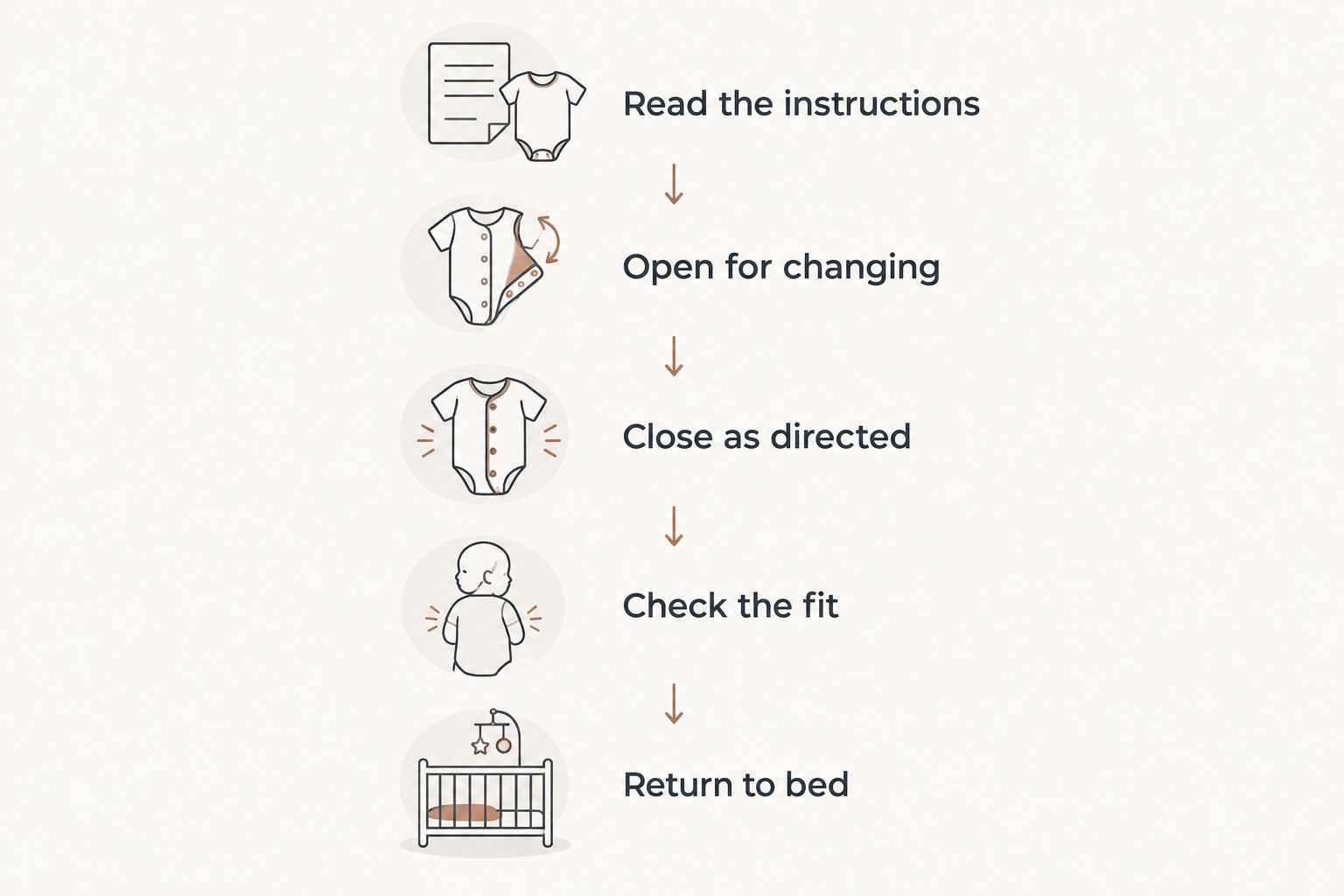
You don’t have to memorize a complicated routine. Use the same short sequence each time:
- Read the instructions. Know which fasteners open for a change and how they close again.
- Open for changing. Move the garment out of the diaper area without pulling it toward the face.
- Close as directed. Return every required fastener to the intended position.
- Check the fit. Look at the neckline, sleeves, and lower section before putting your baby down.
- Return to bed. Place your baby on their back in their clear, separate sleep space.
The last check matters even when the diaper change felt easy. A missed closure or folded section can change how clothing sits on your baby.
Keep the changing space within reach of what you need, and stay with your baby throughout the change. Don’t add safety pins, clips, or improvised ties to make a gown work. If its closure no longer functions correctly, use another garment.
Why suitability varies from gown to gown
The word convertible describes a feature, not a safety rating. These details determine whether an individual gown works for your baby:
- Intended use. Sleepwear instructions matter more than a product photograph or a general description of the category.
- Neck and shoulder fit. Openings must keep the garment in place without allowing fabric to reach the face.
- Closure design and condition. Fasteners need to work as intended, with no loose components or makeshift repairs.
- Lower-body fit. Each permitted configuration must allow comfortable hip and leg movement without pulling the garment out of position.
- Total warmth. Fabric, added clothing, wearable bedding, and the room all contribute to how warm your baby becomes.
- Your baby’s needs. Growth, rolling attempts, prematurity, and individualized care instructions can change what clothing is appropriate.
Softness is a comfort feature, not proof of sleep safety. Bamboo-derived fabric, organic cotton, or a familiar brand name doesn’t remove the need to check fit and follow safe sleep guidance.
Use this same checklist when a hand-me-down arrives. A garment that worked for another baby still needs to fit yours and have functioning closures.
How warm should a baby be in a gown?
Dress your baby for the environment, not for how cold their hands happen to feel. The American Academy of Pediatrics advises generally using no more than 1 extra clothing layer compared with what an adult would wear comfortably in the same environment.
That isn’t an instruction to add a layer every time. A gown, undershirt, and sleep sack all contribute warmth. Look at the whole outfit.
Check for overheating signs such as sweating, a hot chest, or flushed skin. Don’t use an indoor sleep hat to make up for uncertainty about warmth, and don’t add loose blankets around the gown.
For your 2026 bedtime routine, make warmth a separate check from fit. A garment can fit well and still be part of an outfit that’s too warm. If you’re unsure how to dress a baby with specific health needs, ask their pediatrician for individualized advice.
Can a baby wear a convertible gown after starting to roll?
Rolling doesn’t automatically rule out ordinary, correctly fitted sleep clothing. It does change the rules for swaddling: stop swaddling when your baby shows signs of trying to roll, according to American Academy of Pediatrics guidance.
A convertible gown isn’t automatically a swaddle. Check whether the garment or anything worn over it restricts the arms or wraps the body as a swaddle would.
Keep placing your baby on their back at the start of every sleep. Once your baby can roll independently in both directions, the American Academy of Pediatrics says you don’t need to keep turning them back. The sleep surface must still remain firm, flat, and clear.
Don’t use wedges, rolled towels, or positioners to hold a baby in place. Changing clothing doesn’t make those additions appropriate.
Is a convertible gown suitable for a preemie?
For a premature baby, the care team’s instructions come before a general clothing recommendation. In the NICU, clothing choices must account for the baby’s condition, temperature needs, monitoring, and access to medical equipment.
Goumikids’ preemie essentials were developed with Penn State Health Milton S. Hershey Medical Center and NICU nurses. That collaboration is relevant to thoughtful preemie design; it doesn’t mean every garment is appropriate for every hospitalized baby.
For a practical example, the Preemie 24 Hour Convertible Gown in Rose converts from gown to sleeper with 1 snap, according to its product description. That explains its dressing function, not a medical benefit or a guarantee of sleep safety.
Goumikids convertible gowns are best for parents who want gown-to-sleeper dressing in one garment. The benefit is adaptability; the limitation is that you still need to confirm the exact item’s fit, instructions, and suitability for your baby.
After discharge, follow the care team’s home sleep and dressing instructions. Don’t use a newborn-size gown as a substitute for appropriate preemie fit.
Can you put a blanket over a baby wearing a gown?
Don’t add a loose blanket to an infant’s sleep space. The National Institutes of Health’s Safe to Sleep program recommends keeping soft objects and loose bedding out, regardless of the clothing your baby wears.
If your baby needs additional warmth, use appropriate sleep clothing or a correctly fitted, non-weighted wearable blanket. Check the combined layers and the manufacturer’s instructions.
A gown’s open lower section isn’t a reason to tuck a blanket around your baby. Choose clothing that meets the warmth need without adding loose bedding.
FAQ
Is it safe for a baby to sleep in a convertible gown every night?
A baby can sleep in a convertible gown when it is intended for sleep, fits correctly, and is used as directed. Check its condition and fit regularly, and always use a firm, flat, clear sleep surface.
Is a convertible gown the same as a sleep sack?
A convertible gown is not automatically a sleep sack. A gown is clothing, while a non-swaddling sleep sack serves as wearable bedding; follow the exact item's intended use.
Can my baby sleep in a gown with the bottom open?
Use an open-bottom configuration only if the manufacturer's instructions permit it for sleep. The garment must remain correctly positioned and clear of the face without improvised knots or ties.
Can my baby wear a gown under a sleep sack?
A gown can be worn under an appropriate sleep sack if both items fit correctly and the combined layers don't overheat your baby. The American Academy of Pediatrics generally advises no more than 1 extra clothing layer compared with a comfortably dressed adult.
Should I stop using a gown when my baby starts rolling?
Rolling does not automatically require stopping ordinary sleep clothing, but you must stop swaddling when your baby shows signs of trying to roll. Confirm that the gown and any added garment do not function as an arm-restricting swaddle.
Are Goumikids convertible gowns guaranteed to make sleep safer?
Goumikids convertible gowns are clothing, not a guarantee of safer sleep. Their conversion features do not replace correct fit, back sleeping, or a firm, flat, clear sleep surface.
Can a premature baby sleep in a convertible gown at home?
A premature baby's clothing should follow the discharge team's instructions and fit that baby correctly. Ask the care team about the exact garment if your baby has temperature, monitoring, or other individualized needs.
Does organic or bamboo-blend fabric make a gown safe for sleep?
A fabric name does not establish that a gown is safe for sleep. Intended use, fit, garment condition, warmth, and the sleep environment remain the important checks.
One last thing
The useful final check isn’t whether the gown looks tidy. It’s whether the neckline stays in place and your baby’s sleep space is clear.
Before you step away, look from the garment to the mattress. Check for fabric near the face, an unfinished closure, or a blanket left behind after the change. Then confirm that your baby is on their back.
For 2026, keep that routine simple enough that another caregiver can repeat it. Show them the permitted gown configuration and where your baby sleeps. An adaptable outfit helps with dressing; a consistent safe sleep setup remains essential.