



How long should a preemie wear mittens after leaving the NICU?

There’s no fixed number of days or weeks that every preemie should wear mittens after leaving the NICU. Follow your baby’s discharge instructions, and ask the care team whether mittens are still needed at home; if they’re only for scratches, ask about leaving hands uncovered during supervised awake time rather than continuing around the clock. This 2026 guide helps you separate a hospital-specific reason from an everyday clothing choice.
- How long should a preemie wear mittens after NICU? Follow the discharge plan, not a universal countdown.
- Preemie mittens used around medical equipment need a care-team review before you change the routine.
- Goumikids preemie mitts offer a clothing option; they don’t determine when your baby should stop wearing mittens.
- Ask about supervised bare-hand time, nail care, and whether mittens belong in your baby’s sleep routine.
How long should a preemie wear mittens after leaving the NICU?
Use the reason for the mittens—not the discharge date—to decide when to stop. A baby who wore mittens around hospital equipment has a different question from a baby whose nails occasionally scratch their cheek. Neither situation creates a standard wear period for every premature baby.
Before you carry the hospital routine home, check whether the discharge paperwork mentions hand coverings. If it does, follow those instructions and ask when the team wants to review them. If it doesn’t, ask whether mittens are optional rather than assuming they’re required.
General advice about how long newborns need mittens provides background, but it doesn’t replace a preemie’s individual discharge plan. Your baby’s medical needs matter more than another family’s timeline.
| Situation at home | Best for | Main benefit | Limit or concern | Next move |
|---|---|---|---|---|
| Supervised awake time with uncovered hands | Babies whose team hasn’t prescribed hand coverings | Lets you see the hands and allows direct touch | Doesn’t provide a fabric barrier against fingernails | Ask the team how to include bare-hand time |
| Mittens used for occasional scratching | Babies whose team agrees that temporary hand covering is appropriate | Creates a barrier between nails and skin | Needs fit checks and doesn’t replace nail care | Review whether the mittens are still useful |
| Mittens included in a medical care plan | Babies with an explicit clinician-directed reason | Keeps clothing choices consistent with the care plan | A general clothing guide cannot set the stop date | Ask the prescribing team when to reassess |
This comparison isn’t a schedule. It’s a way to identify which question you need answered before you keep using mittens—or put them away.
Why this matters
Coming home can make a small clothing decision feel bigger than it is. You’ve watched nurses check equipment, change clothes, and handle tiny hands. Now you’re doing diaper checks half asleep, and it’s easy to keep every hospital habit because it feels familiar.
A routine used in the NICU isn’t automatically a home-care requirement. Some decisions were tied to care happening there. Others were simply practical ways to dress your baby.
For your 2026 home routine, ask the team to separate those two things clearly. You don’t need to guess which category mittens belong in. You need an answer that applies to your baby now.
The goal isn’t to stop mittens as quickly as possible or keep them on as long as possible. It’s to use them for a clear reason, check that they fit, and know when that reason no longer applies.
Start with the discharge plan
A useful conversation begins with what happened in the hospital. Tell the clinician why you understood your baby was wearing mittens, then ask whether that reason still applies at home. Don’t assume the purpose from the clothing alone.
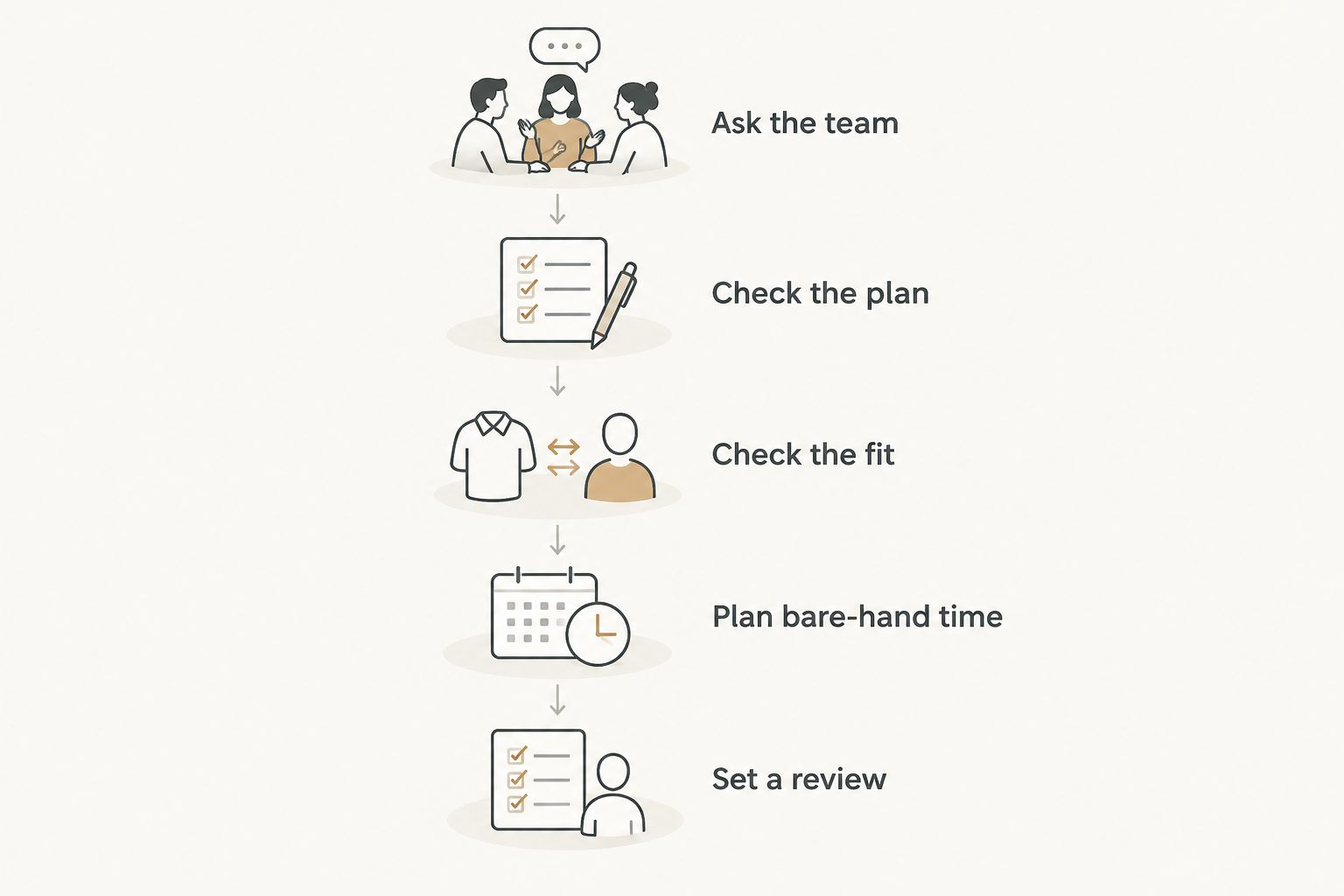
Use these steps at discharge or at your next follow-up:
- Ask the team. Were the mittens for scratching, warmth, or a specific part of care? Ask whether that purpose continues after discharge.
- Check the plan. Look for written instructions about hand coverings. If the instructions aren’t clear, ask for clarification before changing a prescribed routine.
- Check the fit. Ask someone on the team to show you how the actual mittens should sit on your baby’s hands and wrists.
- Plan bare-hand time. Ask when hands can be uncovered, including during awake interaction, feeding, and skin checks.
- Set a review. Ask what would mean the mittens are no longer needed and who should make that decision.
These are questions, not a home treatment protocol. A baby with medical equipment or a skin concern needs guidance specific to that situation.
Keep the answer with the rest of your discharge notes. Another caregiver should be able to understand why the mittens are being used and when to take them off. That makes the next change simpler without turning clothing into another complicated task.
If the mittens are only for scratches
If your baby’s team confirms that mittens are only an optional scratch barrier, discuss using them when needed rather than treating them as permanent clothing. Also ask someone to demonstrate safe nail care. Covering the hands doesn’t address a sharp nail underneath.
Uncovered hands let babies touch their own bodies and their surroundings. That’s a reason to ask about bare-hand opportunities, not a reason to ignore a medical instruction. Supervised awake time gives you a chance to watch what your baby actually does with their hands.
You don’t need to create a timed trial or work toward an online deadline. Ask whether your baby can have hands uncovered during an ordinary awake moment. Then notice whether scratching is still a problem worth discussing.
If scratching breaks the skin, the skin looks irritated, or you’re unsure how to manage the nails, contact your pediatric team. Don’t solve an ongoing skin problem by tightening the mittens or adding more coverings.
Optional scratch mittens should have a purpose you can name. If that purpose is no longer there, ask whether it’s time to leave them off.
Why Goumi's hospital history doesn't set a home wear schedule
Goumi developed its preemie mittens with NICU clinicians at Penn State Hershey Children's Hospital, using feedback from patient testing, nurses, and parents. Historical 2016 guidelines named Goumimitts for selected intubated babies and babies judged at risk of pulling lines or breathing tubes, with removal during each care session for skin checks and laundering when soiled.
Those are historical hospital practices, not current policy or evidence that mittens make home sleep safer. They don't set a stop date after discharge. Ask your baby's team which instructions apply at home.
If the mittens were part of NICU care
If staff used mittens in connection with medical equipment, ask the discharge team what changes at home. The answer depends on the equipment and the care plan. It cannot be inferred from a product label or another baby’s experience.
Don’t use ordinary baby mittens as a substitute for prescribed equipment protection. Don’t add straps, tape, or other improvised ways to keep your baby’s hands covered. Ask the team for the approved approach instead.
If your baby still has equipment at home, bring the mitten question to the clinician responsible for that equipment. Ask whether hands should be covered, when they should be uncovered, and what signs require a call.
You can make that conversation plain: explain that your baby wore mittens in the NICU and ask whether they’re still needed now. Request a written answer if several caregivers share care. Everyone should be working from the same instructions.
Why mitten use varies
A useful answer depends on your baby’s current situation. These factors explain why one family’s stop date isn’t a rule for another:
- The original reason. Scratch protection and a clinician-directed equipment precaution are different uses.
- The discharge instructions. An explicit care instruction takes priority over general clothing advice.
- The current fit. A mitten that fitted earlier needs another check as your baby grows.
- The condition of the skin. Irritation or broken skin calls for clinical advice, not simply more covering.
- Whether scratching continues. A scratch barrier needs reassessment if the problem it addressed has changed.
- The activity. Ask separately about awake time, feeding, and sleep rather than assuming one answer covers everything.
For a 2026 follow-up visit, bring the actual mittens if possible. It’s easier to discuss fit when the clinician can see the item you’re using. A package marked preemie doesn’t answer every fit question.
Check the hands, not just the closure
A mitten staying on doesn’t prove it fits well. Take it off to look at the skin and check the wrist rather than judging only from the outside. Ask your care team what a comfortable fit should look like for your baby.
Watch for pressure marks, rubbing, swelling, or changes in the appearance of the fingers. Remove a clothing item that appears to be causing pressure and contact the pediatric team for advice. Concerning color changes or a baby who seems unwell need prompt medical assessment.
Also check the inside of the mittens for loose threads and damage. Follow the item’s care instructions and check it again after washing. Don’t keep using a damaged mitten just because it’s the one that usually stays on.
If mittens repeatedly slip off, don’t compensate by fastening them increasingly tightly. Recheck the size and ask whether a different clothing choice is appropriate. Staying on and fitting comfortably both matter.
Choose clothing after you know the plan
Shopping comes after the care question. First establish whether your baby needs mittens and how they’ll be used. Then compare the actual size and closure rather than choosing solely by color or the word preemie.
Goumikids preemie mitts suit parents looking for preemie-size hand coverings with a two-part closure. The checked Cloud and Sandstone preemie mitt listings identify that adjustable closure and 70% bamboo viscose / 30% organic cotton blend. They don’t establish a post-NICU wear duration.
The benefit is practical: a purpose-made hand covering with a stated closure feature. The limit is just as important: Goumikids baby mittens don’t replace a fit assessment, skin checks, or instructions from your baby’s team.
For a 2026 purchase, check the current product details and size guidance for the exact item. Features vary by style. Don’t assume every mitten has the same fabric composition or construction.


Both card descriptions identify the same practical closure feature. There’s no basis here for choosing one color over the other for medical use, fit, or a longer wearing period. Check the exact item with your baby’s team if mittens are part of prescribed care.
Does corrected age tell me when to stop mittens?
Corrected age doesn’t provide a universal mitten stop date. Clinicians use corrected age when assessing aspects of premature babies’ development, but that doesn’t turn it into a clothing countdown.
Ask whether your baby still needs the hand covering for its original purpose. That question is more useful than deciding that a particular birthday means mittens must stay on or come off.
Should my preemie wear mittens all day?
Don’t assume a preemie needs mittens all day after discharge. Ask whether your baby has a specific instruction requiring them and whether uncovered hands are appropriate during supervised awake time.
A stay-on closure describes how clothing fastens. It isn’t an instruction to use the item continuously.
Can my preemie sleep with mittens on?
Ask your discharge team whether separate mittens belong in your baby’s sleep clothing. A loose or poorly fitting item shouldn’t be treated as harmless simply because it’s small.
The American Academy of Pediatrics' safe-sleep guidance, checked in October 2026, recommends back sleeping on a firm, flat surface without loose bedding or soft objects. This is general sleep-environment guidance, not a mitten-specific approval or ban. A separate mitten's closure doesn't establish overnight safety; clarify your baby's individual instructions.
FAQ
How long should a preemie wear mittens after NICU discharge?
There’s no fixed wear period for every preemie after NICU discharge. Follow the discharge instructions and ask whether the original reason for mittens still applies at home.
Can I take my preemie’s mittens off when we get home?
Check the discharge plan before changing a prescribed mitten routine. If mittens were only an optional scratch barrier, ask the team about supervised awake time with uncovered hands.
Does my baby need mittens until their due date?
A due date doesn’t establish a universal mitten stop date. The decision depends on why your baby is wearing mittens and what the care team recommends now.
Are stay-on mittens meant to be worn all day?
A stay-on closure doesn’t mean mittens should be worn continuously. Ask when hands should be uncovered for interaction, skin checks, and any care your baby needs.
What should I do if mittens leave marks on my preemie’s wrists?
Remove mittens that appear to be causing pressure and contact your pediatric team for fit advice. Swelling, concerning finger-color changes, or a baby who seems unwell need prompt medical assessment.
Can mittens replace trimming my preemie’s nails?
Mittens don’t replace nail care. Ask your care team to show you a safe approach for your baby, especially if scratching continues or the skin is irritated.
What should I ask about mittens at a 2026 follow-up visit?
Ask why mittens are needed, when hands can be uncovered, and what would mean it’s time to stop. Bring the actual pair so the clinician can help assess the fit.
One last thing
Before the next caregiver takes over, write down the reason for the mittens beside the care instructions. Keep it short and specific. If you can’t explain why your baby still needs them, that’s the question to bring to the team—not a reason to invent a deadline.
You don’t need a perfect mitten schedule. You need a clear plan for your baby.